Thaler v. Perlmutter: Machines Cannot Be Authors
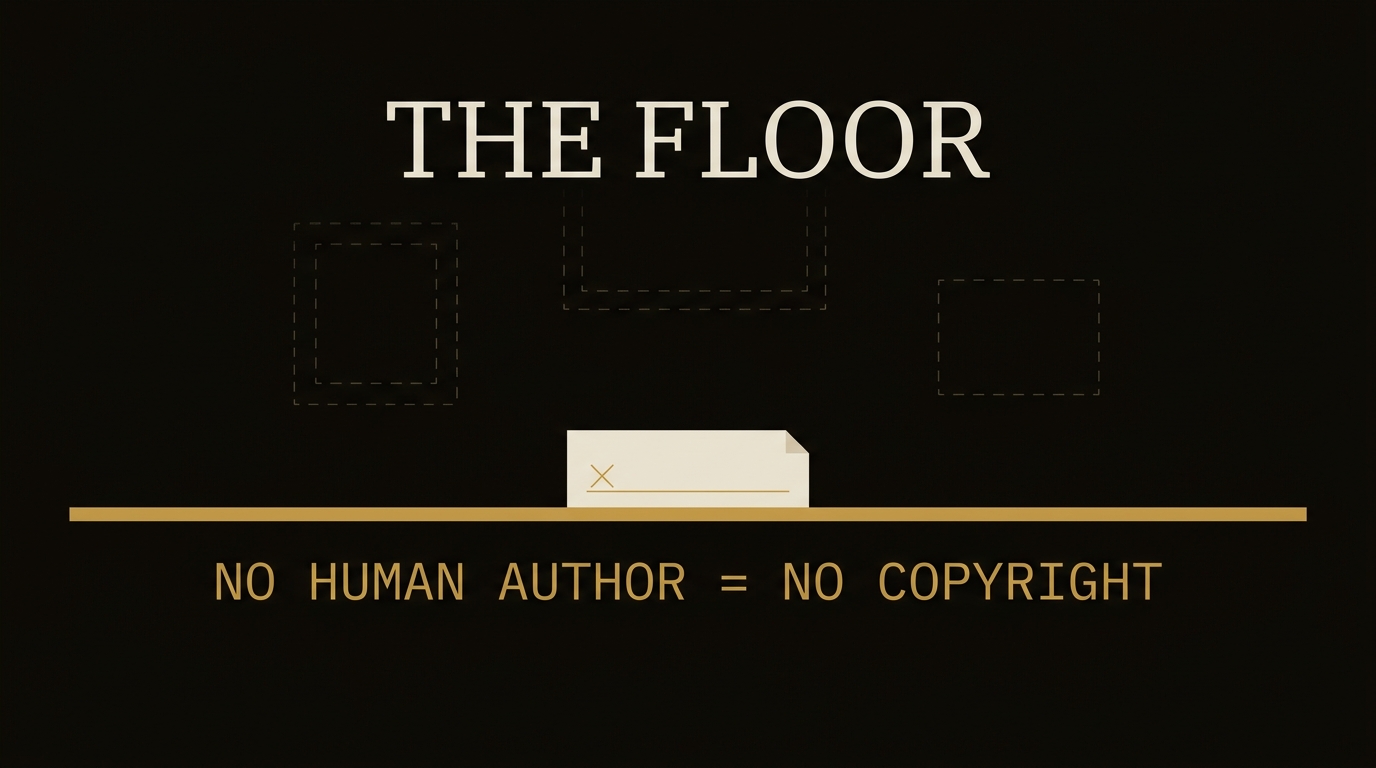
Most AI copyright fights are arguments about degree. How much did the human do? Was it enough? Thaler v. Perlmutter is not that kind of case. It's the one that asks whether there needs to be a human at all, and the answer, now final, is yes.
Stephen Thaler built a system he calls the Creativity Machine. He says it generated a piece of visual art, "A Recent Entrance to Paradise," on its own. When he applied to register the copyright, he did something almost nobody else does. He listed the machine as the sole author and himself as merely the owner, by virtue of owning the machine. No human author. Just the AI.
The Copyright Office denied it. Thaler sued. He lost in the district court. He appealed to the D.C. Circuit, and on March 18, 2025, that court affirmed. He petitioned the Supreme Court, and on March 2, 2026, the Court denied certiorari, letting the ruling stand. The question is now settled at the only level that fully settles things.
The statute does the work
The D.C. Circuit didn't reach for policy or speculation about the future of art. It read the Copyright Act and found that the text assumes a human author throughout.
The Act gives an author rights that last for the author's life plus 70 years. A machine has no life. It speaks of an author's heirs, an author's widow and children, an author's nationality and domicile. It conditions ownership on the author's intentions. None of these provisions make sense applied to software. They presuppose a person. So the court concluded that a "work of authorship" under the statute must be authored, in the first instance, by a human being. A work with no human author anywhere in its creation is categorically outside the system.
This is why the case matters even though Thaler's facts are unusual. He removed the human on purpose. He wanted a clean test of whether a machine, standing alone, could hold authorship. The courts gave him a clean answer. It cannot. There is no copyright in a work with no human author, full stop.
Why this is the floor, not the ceiling
Think of AI copyright law as having two layers.
The bottom layer is the threshold question Thaler answers: is there a human author at all? If the answer is no, you stop. Nothing is protectable. The work falls into a void where neither the machine nor the machine's owner can claim anything.
The top layer is the interesting one, and it's where every other case lives. Once you clear the floor, once a human is genuinely involved, the question becomes how much human contribution there is and which parts it covers. That's Zarya of the Dawn, where the text and arrangement were protected and the raw images weren't. That's Theatre D'opera Spatial, where 624 prompts didn't add up to authorship of the core image. That's A Single Piece of American Cheese, where the human selection and arrangement carried a valid claim.
Thaler doesn't engage any of those nuances because his case never gets off the ground floor. He didn't argue he contributed too little. He argued he contributed nothing and the machine should be the author anyway. So his case sets the baseline that all the degree-arguments build on top of. You need a human author. After that, we can talk about how much.
What it doesn't decide
Be precise about the holding, because it's easy to overclaim.
Thaler does not say AI-assisted works can't be copyrighted. The Office has registered several. It does not say using AI poisons your copyright. It does not say a prompt can never be creative enough. All it says is that when there is no human author at all, there is no copyright. That's a narrow rule with enormous reach, because it defines the entry condition for everything else.
The Copyright Office's own guidance, published in March 2023 and expanded in its January 2025 report on copyrightability, lines up exactly with this. A work is registrable to the extent a human determined its expressive elements. Thaler is the case proving the floor under that sentence. If a human determined nothing, there's nothing to register.
The practical takeaway
If you make things with AI, Thaler tells you the one thing you absolutely cannot do: hand the entire creative act to the machine and expect to own the result. Somewhere in the process, a human has to have made expressive choices that the work reflects. That's non-negotiable, and now it's non-appealable.
The harder, more common problem is the layer above. You probably did make creative choices. The question is whether you can show them. When a registration gets challenged, or when you need to prove your work isn't a Thaler-style empty claim, you need a record of the human decisions that put you above the floor in the first place.
Copyrightable builds that record while you create. It captures the expressive choices you make, the selections, the arrangements, the modifications, so that when someone asks "where's the human author here," you have a timestamped answer instead of an argument. Thaler proves you need a human in the loop. Install the hook and prove you were the one. Read the D.C. Circuit's opinion and the Copyright Office's AI guidance to see exactly where the floor sits.
Related reading
- Every AI Copyright Lawsuit Worth Knowing: The Complete Guide
- Zarya of the Dawn: What the Copyright Office Actually Kept
- Theatre D'opera Spatial: 624 Prompts Weren't Enough
Want the record behind your own work? See how the methodology scores authorship.
Want a contemporaneous record of how you authored your work?
Try it free