Zarya of the Dawn: What the Copyright Office Actually Kept
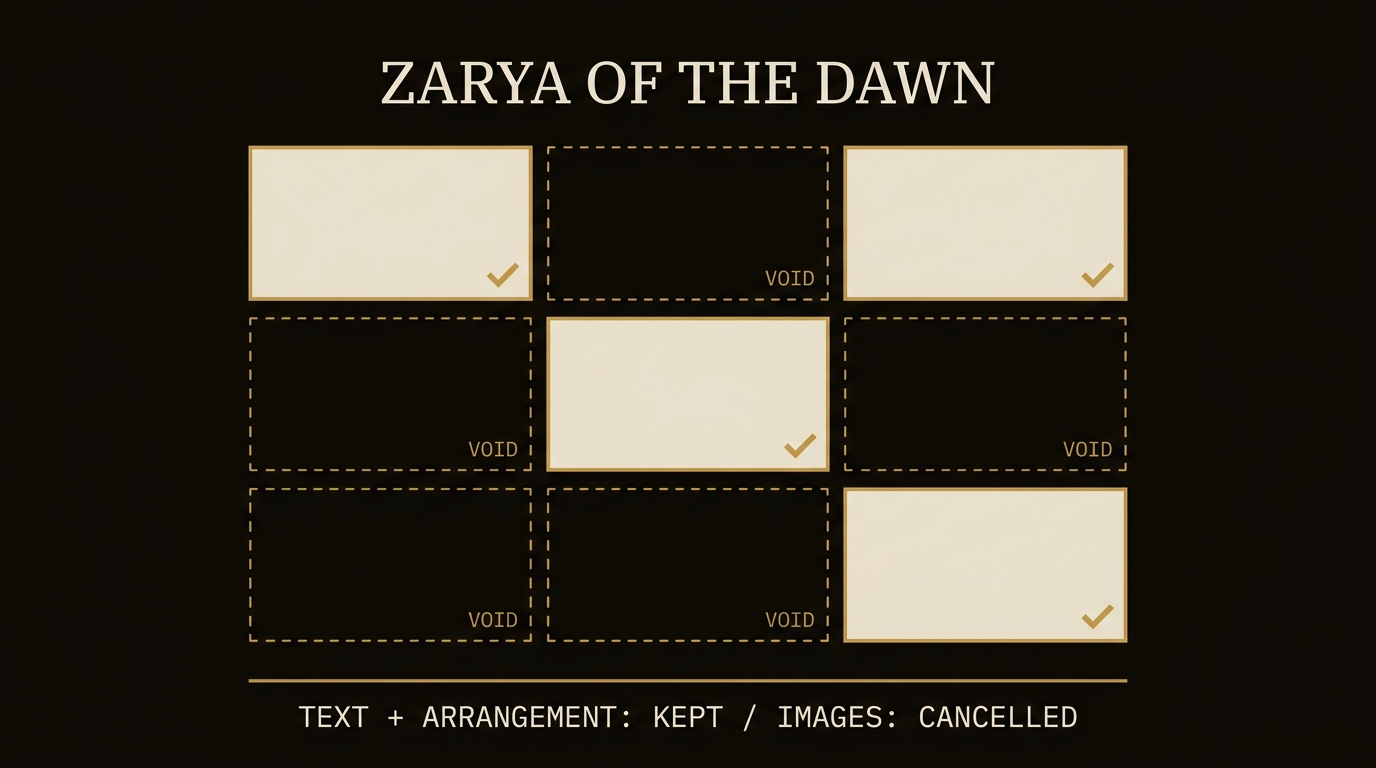
The most useful AI copyright case isn't the one everyone calls a loss. It's the one where the Copyright Office said yes and no in the same letter.
Kris Kashtanova made a graphic novel called Zarya of the Dawn. The story, the characters, the layout, all of it came together as an 18-page comic. The images inside were generated with Midjourney. In September 2022 the Office registered the whole thing. Standard certificate, no asterisks.
Then someone noticed Kashtanova had been posting about using Midjourney, and the Office reopened the file. After months of correspondence, on February 21, 2023, it did something it rarely does. It cancelled the original certificate and issued a new, narrower one in its place.
Read that letter carefully and you get the clearest map anyone has of where the line sits.
What the Office kept
The new registration covers two things. First, the text. Kashtanova wrote every word of the story, and the Office never doubted that a human did. Pure human authorship, fully protected.
Second, and this is the part people skip past, the Office kept the "selection, coordination, and arrangement" of the text and images. In plain terms: the compilation. Kashtanova chose which images to use, decided their order, paired them with specific text, and arranged everything into a sequence that tells a story. That arrangement is a creative act, and it belongs to a person. So it's protected too.
The letter spells it out. Kashtanova "is the author of the Work's text as well as the selection, coordination, and arrangement of the Work's written and visual elements." That sentence is doing a lot of work. It says the human contribution to an AI-assisted project can be real and registrable even when the underlying images are not.
What the Office refused
The individual Midjourney images. Each picture, on its own, the Office would not protect.
The reasoning matters more than the result. The Office didn't say the images looked too machine-made, or that Kashtanova hadn't tried hard enough. It said the images "are not the product of human authorship" because Midjourney, not Kashtanova, determined how they actually looked. A user types a prompt. Midjourney decides what to render. The gap between the request and the output is where the machine's contribution lives, and the law won't assign that contribution to a person who didn't make it.
Kashtanova had described an iterative process, generating, picking, re-prompting, refining. The Office looked at that and still concluded the expressive output of each image came from the tool. Influence over a result is not the same as authoring it.
Why a "rejected" case is actually a manual
Headlines called Zarya a defeat for AI art. That misreads what happened. A graphic novel got registered. The story is protected. The arrangement is protected. The thing that wasn't protected, the raw generated images, is exactly the thing the law has never protected, because no human authored it.
If you strip the case down to its instruction, it reads like this. When you build something with AI, the parts a human creatively determined are yours. The parts the machine determined are not. Your job, if you want protection, is to make the human parts real and to be able to show them.
Kashtanova's text was easy to prove, she typed it. The arrangement was provable because the finished comic showed the choices. The images failed not because AI touched them but because nobody could point to the human decision that fixed their final expressive form.
That's the whole lesson, and it shows up again in every case that followed. Theatre D'opera Spatial lost because the artist couldn't isolate protectable human authorship from the Midjourney output. A Single Piece of American Cheese won because the human selection and arrangement carried the claim. Zarya sits right in the middle and explains both.
What this means if you make things with AI
The Office is not hostile to AI-assisted work. It registered Zarya. It registered the cheese. What it requires is a human author whose creative decisions you can actually identify, and a willingness to disclaim the parts the machine produced on its own.
Selection, coordination, arrangement. Those three words from the Zarya letter are now the test you'll be measured against. The catch is that you usually have to prove your contribution after the fact, reconstructing from memory which images you chose, why you ordered them the way you did, what you changed and when. Most people can't. The record doesn't exist until someone challenges the work, and by then it's too late to build.
Copyrightable records those decisions as you make them. The selection you made, the arrangement you settled on, the modifications you applied, each one timestamped at the moment it happened. Install the hook and your next AI-assisted project carries the same kind of evidence the Office used to keep half of Zarya, captured from the first prompt instead of reconstructed under pressure. Source: the USCO's letter to Kashtanova's counsel.
Related reading
- Every AI Copyright Lawsuit Worth Knowing: The Complete Guide
- Theatre D'opera Spatial: 624 Prompts Weren't Enough
- Thaler v. Perlmutter: Machines Cannot Be Authors
Want the record behind your own work? See how the methodology scores authorship.
Want a contemporaneous record of how you authored your work?
Try it free